
Retainers
Monthly infrastructure and operations support with defined coverage, monitoring, task credits, and response commitments. Retainers are built for sites and systems where downtime has a cost.
For one-off infrastructure work without an ongoing commitment, see Tasks.
Business hours
Standard
$500 / month
Business-hours coverage for production sites where overnight response is not required.
- Coverage: 9 AM – 6 PM ET
- Monday – Friday
- Critical response: 2 hours
- Monitoring: 5 sites, 2 servers
- Task credits: 6 / month
- Overage rate: $125 / credit
- Alert response during coverage window
- Incident triage, stabilization, and root cause
- Infrastructure tasks within credit allocation
- Off-hours incidents queued for next business day
Extended hours
Extended
$1,100 / month
Extended-hours coverage seven days a week for systems that run beyond business hours.
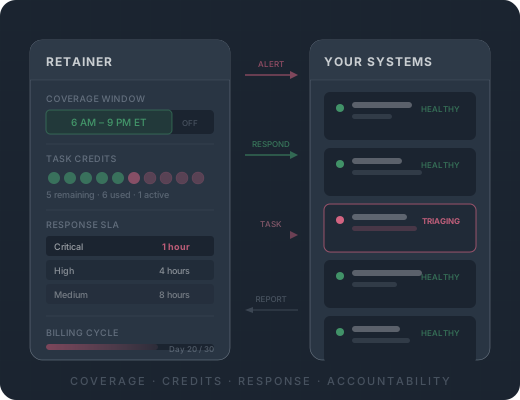
- Coverage: 6 AM – 9 PM ET
- 7 days / week
- Critical response: 1 hour
- Monitoring: 10 sites, 4 servers
- Task credits: 12 / month
- Overage rate: $110 / credit
- Everything in Standard, plus:
- Weekend and evening alert response
- Proactive reliability and performance reviews
- Off-hours incidents queued for next coverage window
24/7 coverage
Critical
$2,200 / month
Around-the-clock coverage with rapid response for systems where downtime costs revenue.
- Coverage: 24 / 7 / 365
- Including holidays
- Critical response: 30 minutes
- Monitoring: 15 sites, 6 servers
- Task credits: 18 / month
- Overage rate: $100 / credit
- Everything in Extended, plus:
- Overnight and holiday alert response
- 30-minute critical response at any hour
- Priority over all other engagements
All retainers are month-to-month. No long-term contracts required.
What Every Retainer Includes
Regardless of tier, every retainer engagement includes the following.
Monitoring & Alert Response
Uptime, performance, SSL, DNS health, and server resource monitoring. Alerts are triaged and responded to within your coverage window, not just sent to your inbox.
Incident Response & Root Cause
When something breaks, we triage, stabilize, and investigate. You get a root cause analysis and corrective actions, not just a restart and a shrug.
Infrastructure Task Work
DNS changes, server configuration, migrations, hardening, performance tuning, and more — handled through your monthly task credit allocation.
Defined SLA & Accountability
Every retainer includes written response time commitments backed by service credits. If we miss the SLA, it costs us, not just an apology.
Quick Questions & Advisory
Have a question about your stack, a configuration decision, or whether something is worth doing? Ask. Questions that don’t require implementation or active research are answered within your coverage window at no cost — no task credit required. The line is simple: asking is free, doing is a task.
Out of Scope
Retainers cover infrastructure and operations. The following fall outside the engagement scope:
- Application development or feature implementation
- Content, design, or theme changes
- Ongoing third-party vendor management outside defined incident scope
- Work outside defined infrastructure scope
- Emergency response outside the coverage window (available at the out-of-hours rate, see below)
Task Credits
Each retainer includes a monthly allocation of task credits for planned infrastructure work. Credits are based on task complexity, not time spent.
Have a question about your stack, a configuration decision, or whether something is worth doing? Ask. Questions that don’t require implementation or active research are answered within your coverage window at no cost. The line is simple: asking is free, doing is a task.
Alert-driven incident response does not consume task credits either. Credits are for requested work, not emergencies we’re already covering.
Small — 1 credit
Up to 1 hour of effort. Quick, well-defined changes.
DNS record updates, SSL renewal, firewall rule changes, adding a monitoring check, minor configuration adjustments.
Medium — 2 credits
Up to 3 hours of effort. Multi-step work with some investigation.
Server tuning, backup configuration, security patching, staging environment setup, troubleshooting non-critical issues.
Large — 3 to 4 credits
Up to 6 hours of effort. Significant work with planning, testing, and validation.
Site migrations, server provisioning, major configuration overhauls, performance investigations with remediation, architecture reviews.
Tasks are classified before work begins. If a task exceeds its effort ceiling during execution, we pause and communicate what’s needed before continuing. Credits do not roll over between months. Additional credits are available at the overage rate for your tier.
Monitoring
Every retainer includes site and server monitoring with human-reviewed alert response during your coverage window. Sites and servers are counted separately.
Included Monitoring by Tier
Standard
5 sites, 2 servers
Extended
10 sites, 4 servers
Critical
15 sites, 6 servers
Need more? Additional sites at $20/site/month. Additional servers at $40/server/month. Add-ons available on any tier without upgrading.
Monitoring includes uptime checks, response time, SSL certificate expiry, DNS health, and server resource utilization (CPU, memory, disk, load) where applicable. Monitoring runs 24/7 on all tiers; the coverage window determines when alerts are responded to, not when monitoring is active.
Response SLA
Every retainer includes written response time commitments. Response means acknowledgment with initial assessment, not an auto-reply, but confirmation that the issue has been reviewed and work is underway.
All reported issues are triaged and classified within 30 minutes during the active coverage window. If reported outside the window, triage begins within 30 minutes of the next window opening.
Response Times by Tier
Severity
Severity 1 — Critical
Severity 2 — High
Severity 3 — Medium
Severity 4 — Low
Standard
2 hours
6 hours
Next business day
Next scheduled cycle
Extended
1 hour
4 hours
8 hours
Next scheduled cycle
Critical
30 minutes
1 hour
4 hours
Next business day
All response times are measured within the active coverage window. For Standard and Extended, the SLA clock pauses outside the coverage window and resumes when the next window opens. Response time refers to acknowledgment and active investigation, not resolution. Resolution time is not guaranteed.
SLA Accountability
If we miss a response commitment, it costs us. Service credits are applied automatically to the following month’s invoice.
Service Credits per Missed Response
- Missed triage (30-min window): 10% of monthly retainer fee
- Missed Severity 1 response: 25% of monthly retainer fee
- Missed Severity 2 response: 15% of monthly retainer fee
- Missed Severity 3 response: 10% of monthly retainer fee
- Severity 4: No SLA penalty (scheduled work)
Credits are capped at 100% of the monthly retainer fee. If Severity 1 or Severity 2 response commitments are missed more than 3 times in any rolling 90-day period, the client may terminate the retainer immediately with no notice period or cancellation penalty.
SLA Exclusions
The SLA does not apply to issues caused by circumstances outside of Luminfra’s control:
- Changes made by the client or their team without prior notification
- Hosting provider outages or infrastructure failures outside Luminfra’s access
- Third-party service outages (CDN, DNS provider, email services) where resolution depends on the vendor
- Force majeure — natural disasters, widespread internet outages, or similar events
- Failure by the client to provide or maintain required access credentials
Severity & Response Framework
All incidents and alerts are classified using a severity model based on production impact and revenue continuity, not urgency alone. Severity is assigned by Luminfra during triage. If an issue is reclassified, a written justification is provided.
Clients may indicate urgency when reporting an issue. Severity is determined based on actual impact and may be reclassified as additional information becomes available.
Severity 1 — Critical
Production availability or data integrity is directly impacting revenue continuity or core business operations.
- Core revenue path unavailable (e.g., ecommerce checkout down, lead form unreachable)
- Majority of users unable to access production
- Regional outage affecting primary customer base
- Active security compromise (e.g., defacement, unauthorized access, malware injection)
- Data loss or corruption risk (e.g., database crash with no verified backup)
Severity 2 — High
Production is available but degraded without disrupting revenue continuity.
- Elevated error rate (e.g., intermittent 500 errors on some pages)
- Performance degradation (e.g., page load times doubled, server response slow)
- Partial user segment impact (e.g., mobile users affected, one geographic region slow)
- Backup failure without active data loss (e.g., nightly backup job failing for 3+ days)
Severity 3 — Medium
Non-critical functional issues not affecting availability or revenue continuity.
- Non-critical service degradation (e.g., cron jobs not running, staging environment down)
- Email deliverability issues not affecting transactional mail
- SSL configuration warnings without active security impact
- DNS record changes needed for new services or configurations
Severity 4 — Low
Advisory, optimization, or informational items addressed during scheduled engagement cycles.
- Performance optimization recommendations (e.g., caching strategy review, image optimization)
- Infrastructure documentation updates
- Proactive security audit findings with no immediate risk
- Hosting cost optimization or resource right-sizing suggestions
Out-of-Hours Emergencies
Standard and Extended retainer clients can request emergency response outside their coverage window. This is not guaranteed availability; it is best-effort, billed separately.
- Rate: $150 / hour
- Minimum: 1 hour per incident
- Availability: Best-effort, not SLA-bound
- Billed separately from the monthly retainer and task credits
If you’re regularly needing response outside your coverage window, that’s a good indicator the next tier is a better fit. Critical tier clients have 24/7 SLA-backed coverage included, no emergency rates apply.
Common Questions
Do I need to change my hosting provider?
No. Luminfra works on your existing hosting — shared, VPS, dedicated, or managed. We don’t provide hosting and we don’t require you to move. If you ask for a recommendation, we’re happy to suggest options, but there’s no lock-in.
What access do you need to get started?
It depends on the scope, but typically: hosting control panel access, SSH credentials, DNS registrar login, and any relevant application admin access. We walk you through everything during onboarding and can work with your team to set up dedicated access securely.
What happens if my site goes down outside the coverage window?
Monitoring runs 24/7 on all tiers, so the alert is captured regardless. For Standard and Extended, the alert is queued and addressed when the next coverage window opens. If it can’t wait, you can request an out-of-hours emergency response at $150/hour (1-hour minimum). Critical tier clients have 24/7 SLA-backed response — no waiting.
What’s the difference between alert response and task credits?
Alert response is covered by your retainer’s monitoring and response commitment: if a monitor fires and we respond, that doesn’t consume credits. Task credits are for planned, requested work: migrations, configuration changes, server setup, hardening, and similar infrastructure tasks.
Do unused credits roll over?
No. Task credits reset each billing cycle. If you don’t use them, they don’t carry forward. If you need more than your monthly allocation in a given month, additional credits are available at your tier’s overage rate.
Can I add more monitored sites without upgrading tiers?
Yes. Additional sites are $20/month each and additional servers are $40/month each. You don’t need to change tiers just because you have more sites; tiers are about coverage window and response speed, not just monitoring volume.
Is there a long-term contract?
No. All retainers are month-to-month. You can cancel at the end of any billing cycle. We’d rather keep clients because the service is worth it than because they’re locked in.
Can you handle WordPress plugin or theme issues?
Our scope is infrastructure and operations, not application development. If a plugin is causing server errors, performance issues, or outages, that falls within our scope because it’s affecting infrastructure stability. Customizing a plugin, updating content, or building features does not. When we encounter application-level issues during incident response, we’ll identify the root cause and advise on next steps, but the fix may need to come from your developer.
I’m a web agency — can you work behind the scenes with our clients?
Yes. We offer white-label arrangements where Luminfra operates as your infrastructure team without direct client-facing communication. Same service, same SLA, same pricing, and your clients just see it as part of your offering. Contact us to discuss the details.
What if a task turns out to be more complex than expected?
Every task has a defined effort ceiling based on its size classification. If we hit that ceiling during execution, we stop and communicate: here’s what we’ve found, here’s what remains, and here’s what it will take to finish. You approve before we continue. No surprise overages.
Ready to stop worrying about infrastructure?
Pick a tier that fits your coverage needs, or start with a one-off task to see how we work.
No hosting lock-in. Month-to-month. SLA-backed response commitments.